Back to blog
Customer
How WoodUpp’s Finance team took ownership of the numbers - end-to-end
Written by Thomas Wilhelmsen, CEO

Written by Thomas Wilhelmsen, CEO
Two people produce the numbers that drive WoodUpp’s daily decisions across 20+ markets - pulling from ad platforms, the CRM, customer support, e-commerce shops, and their ERP - alongside their regular jobs. Finance doesn’t just consume the output; Finance owns how it gets made. The payoff is concrete: decisions happen at daily cadence instead of waiting on month- close, the team can see exactly where every number came from, and their CFO Steffen can make the output available to the organisation without a controller having to reconcile it first.
"We spend money every day on online marketing. We can’t live with a delayed report that lands one or two weeks after month close. We need it in front of us - every day." - Steffen Silberbauer, Chief Financial Officer
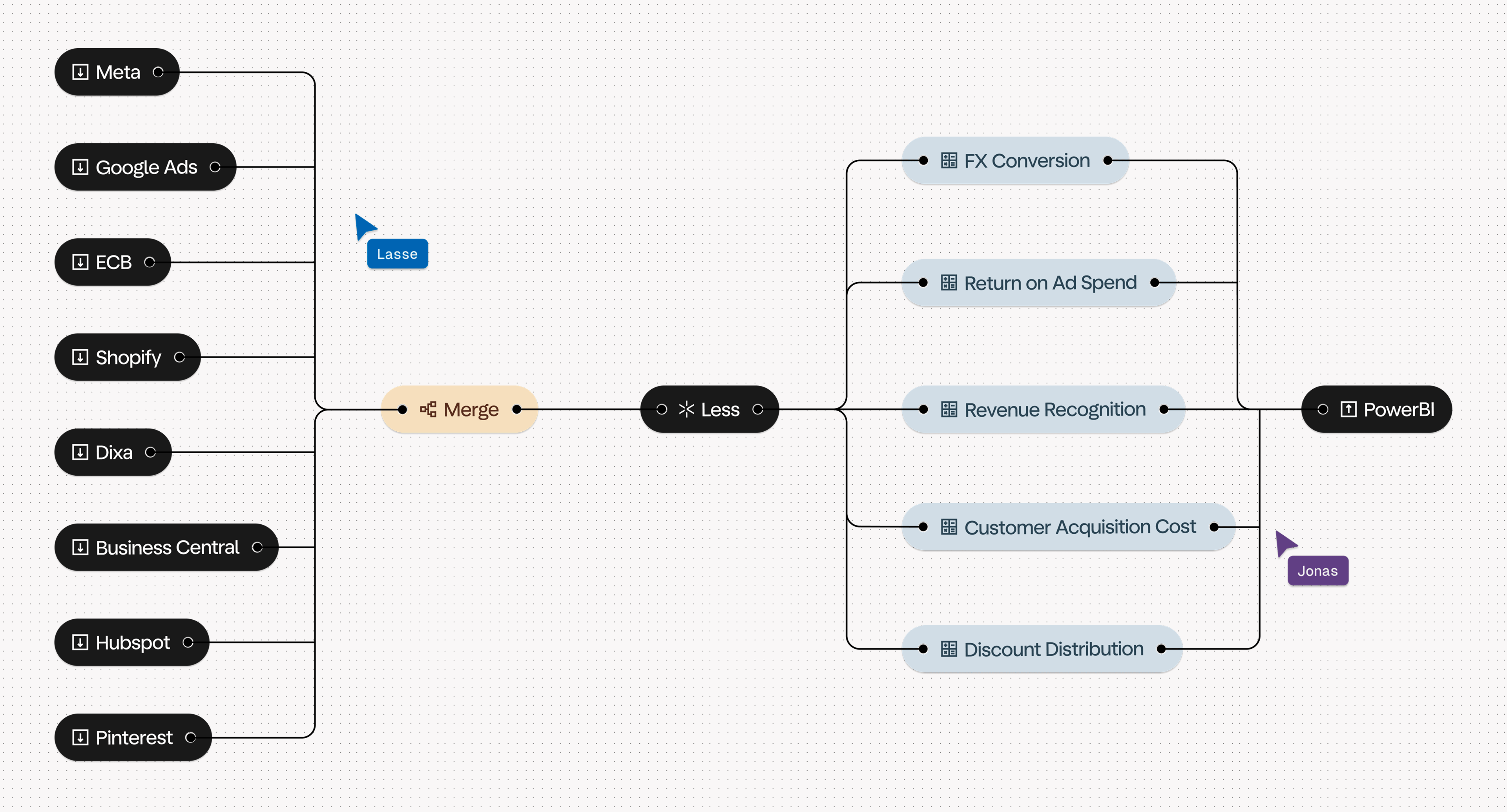
WoodUpp makes interior and exterior design products for offices and homes. The company sells across 20+ markets, operates a B2B channel alongside its consumer business, and runs paid acquisition across Meta, Google, and Pinterest in every region. Behind the scenes: 15+ Business Central company entities, multiple Shopify instances, as well as data spread across HubSpot and Dixa. Less consolidates all of it into a Power BI layer consumed across the whole company.
The setup is led by Finance, with Steffen Silberbauer (CFO) as the main stakeholder. Jonas Holm (Group Business Controller) and Lasse Kristensen (IT Operations) build and run the setup together - Jonas leading on the analytical side and reporting in Power BI, Lasse on the source connections and pipeline in Less, both moving between the two whenever the work calls for it. The whole thing fits into their day jobs.
Before Less, WoodUpp’s analytics setup had hit hard limits. Steffen describes the constraint directly:
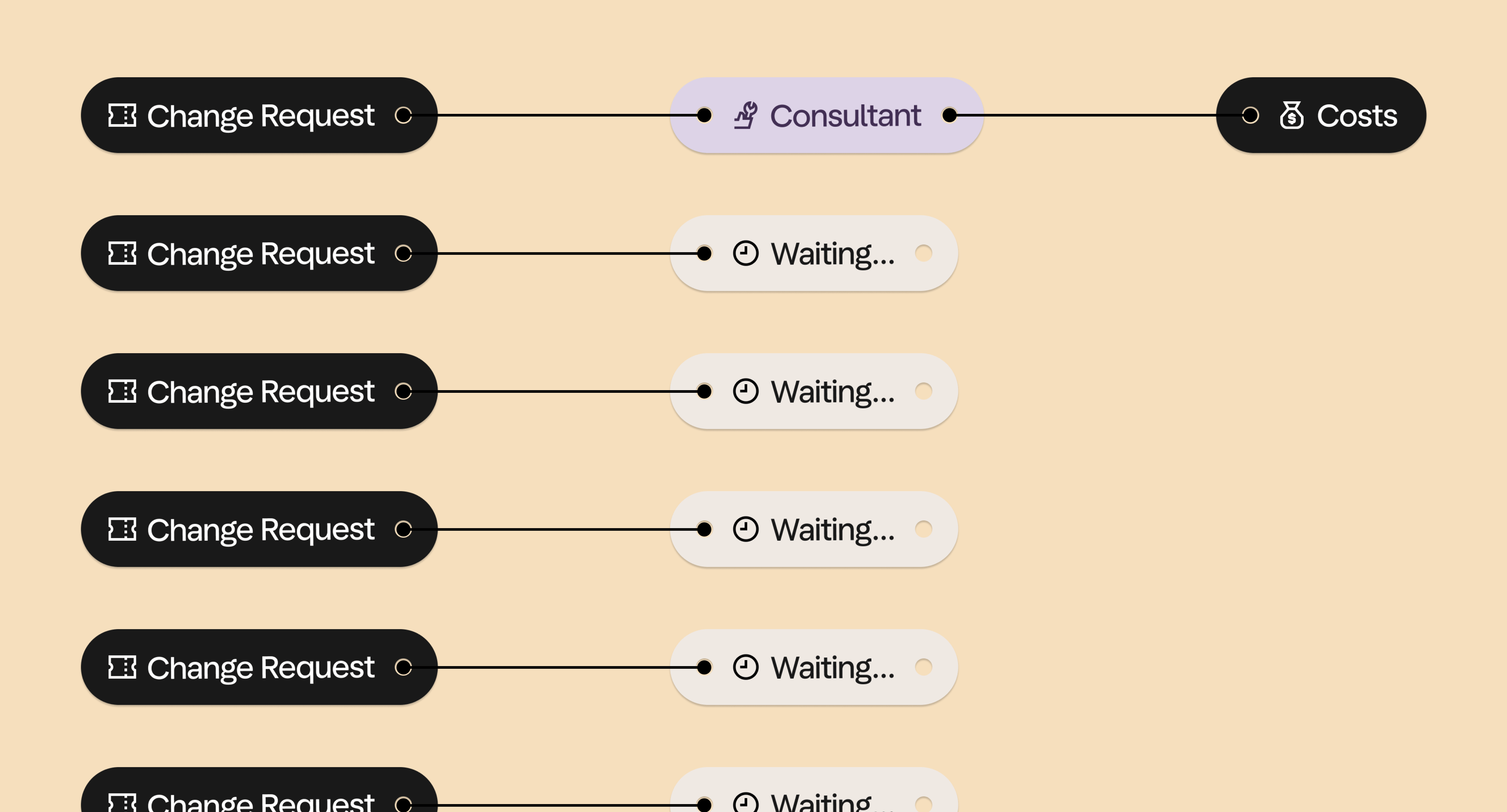
"We were limited by the number of rows in those models, and it was constantly something we had to use external consultants for. It was brutally expensive to change." - Steffen Silberbauer, Chief Financial Officer
Every new question was a ticket. Every new market meant another consultant invoice. Every change to how something was calculated took weeks and exited WoodUpp’s control the moment it was made. The team had been actively looking for a better foundation when they found Less.
The alternatives weren’t obvious. Enterprise data infrastructure was built for companies ten times WoodUpp’s size, with dedicated data teams to operate it and support cycles measured in days.Hiring a BI (Business Intelligence) person would mean adding headcount to solve a problem that didn’t yet warrant a new role. And the row limits made spreadsheet-and-manual-reconciliation a non-starter, even though that’s where many companies WoodUpp’s size still operate.
Less landed in the middle: a tool Finance could operate without a data team, sized for a company that had outgrown spreadsheets but didn’t fit into enterprise infrastructure.
The numbers from Less don’t sit in a monthly close packet. They drive daily decisions across the business - where to lean in on spend, how to price, where revenue is concentrated, where there’s risk in a market - with Finance in the room because the financial view is too central to leave to a monthly review.
Every morning, Jonas spends two minutes verifying that data has flowed correctly into Power BI - a small sanity-check report flags any day where row counts dropped against the running average. That two-minute check is the entire data-quality ritual. Once it passes, the rest of the day’s decisions can run off the numbers.
A sample of what those decisions look like:
ROAS and CAC by market, by channel, by day. Meta, Google, and Pinterest spend pulled directly via Less, combined with revenue from 15+ Business Central entities, sliced by region and campaign. Finance has the daily financial view of what each spent dollar is returning, which makes the conversation with marketing forward-looking: not "what did we spend?" but "where should we lean in next week?"
Line-item discount distribution. Every order’s discounts broken down by item, by category, by market - feeding back into pricing strategy and channel-level promotional logic.
Ten-plus FX conversions running cleanly across the multi-market revenue picture, with Finance trusting the consolidated number because the conversion logic is visible and editable in Less, not buried in a downstream Power BI calculation.
Shopify and Business Central data joined end-to-end, so revenue recognition, AR, AP, and order-level commerce data sit in the same model.
In Steffen’s words:
"We need to constantly have a finger on the pulse - which way are we going, where are we headed. We need that in our business model, because we spend money every day on online marketing, so we need to see what output is coming." - Steffen Silberbauer, Chief Financial Officer
At WoodUpp, Finance is proactive rather than reactive - bringing the financial view of the business into the room while the decisions are still live. ROAS (Return on Ad Spend) and CAC (Customer Acquisition Cost) is the most visible example, but the same logic runs through pricing, revenue recognition, FX consolidation, and the customer-side data from HubSpot and Dixa. Wherever the business makes a decision with financial consequences, Finance has a current view of the numbers behind it.
The operation works because the underlying setup is built for the Finance team to own and operate, not for IT or a consultancy to maintain. WoodUpp connects 15+ Business Central entities, three ad platforms, HubSpot, Dixa, and Shopify into a single pipeline that the team can extend themselves. The day-to-day work of adding new data feeds, debugging issues, and validating outputs all happens in Less. Lasse:
"Before, it could quickly take half an hour to add a new endpoint across all the shops. Now I can do it in five minutes. You just throw new things in." - Lasse Kristensen, IT Operations
The team also publishes new data fields themselves rather than waiting on consultants. Jonas:
"Before, we had to call our consultants, who would publish it to the data warehouse, and then they’d have to figure out - is this the right field? Now we can publish the fields ourselves." - Jonas Holm, Group Business Controller
And when something goes wrong, the team can see exactly where in the data flow it went wrong - visually, step by step - and fix it on the spot. Lasse:
“Instead of digging through code to find the step where it goes wrong, we just see it visually - there’s a Filter that shouldn’t be there. Delete it. Done." - Lasse Kristensen, IT Operations
That visibility is what makes the numbers trustable. Steffen on what makes Less work for a Finance team:
“The real strength of Less is that we have complete control of the data pipeline - from source to output. We can see at a glance when something’s wrong, because it’s visual. There’s no code buried inside." - Steffen Silberbauer, Chief Financial Officer
Finance can stand behind the output because they can know exactly how it was built.
Steffen, talking to other CFOs:
"Most CFOs probably underestimate the workload that comes from not having control of those data integrations. You understand it when you talk it through - the necessity of having a setup where Finance has full visibility from source to output, can validate the numbers, and can confidently send them to the board. But you can only underestimate how much work it gives, if you don’t have control." - Steffen Silberbauer, Chief Financial Officer
The framing other CFOs we work with land on is the same one: you already own the numbers, so why not own how they get made? Finance carries the consequences of every decision made on the numbers - the conversations with the board, the investor calls, the year-end. But at most companies, Finance doesn’t actually own how the numbers get produced. They depend on systems IT maintains, spreadsheets controllers rebuild, consultants paid by the hour. Owning the outcome but not the production is structural debt - it shows up as delay, cost, and reduced trust in the numbers that drive every other decision.
What WoodUpp built with Less is the production behind the numbers that run the business - pulling from ad platforms, ERP, CRM, customer support, and e-commerce, owned end-to-end by Finance, run by two people whose data work fits into their day jobs. That’s what changes when Finance owns the numbers and how they get made: more control, more speed, and more confidence in the numbers that drive every conversation.
Book a 20 minute demo, and we'll run your messiest task live on your actual data.
Set it up